
Updated 2026-05 · DAQiFi engineering team · ← Back to Learn Data Acquisition
Combine multiple sensor types into one acquisition system — environmental monitoring, smart-home health tracking, complex test rigs.
It’s often the case that multiple types of sensors are needed to give an understanding of the physical world. Now that we have explored some of the applications of data acquisition with individual sensors, it is easy to see how integration of multiple sensors could be useful for measuring many different types of data.
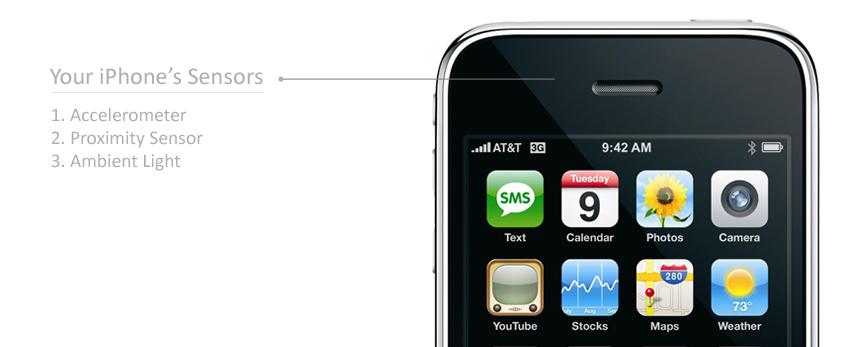
A multi-sensor system is the phrase that can be used to characterize just about every technology we use in daily life. From an iPhone, to a car, to a computer, multiple sensors integrated into unified systems enable advanced acquisition of many different kinds of data. Shown in the figure below are just a few of the many sensors inside an iPhone, a very familiar multi-sensor system.
One example of a worthwhile and important application is the monitoring of patients and elderly people. In 2005, the Simultaneous Tracking and Activity Recognition (STAR) project was published. The goal of this project was to further enable the autonomy of aging people by monitoring them with multiple sensors (including motion, pressure, and contact sensors, among others) inside their own home. This localized system of monitoring allowed elderly people to remain in the comfort of their own home while still giving caretakers, relatives, etc. a full scope of information that could easily be correlated to the health and wellbeing of the elderly.9
Though the examples previously given were of very complicated multi-sensor systems, integration of sensors can be much more simple. For example, something as baseline as an LED lighting up according to certain data values being read by a temperature sensor is still an integrated system. It is fundamental applications such as this that, layered together, can ultimately produce a complex, highly functional system.
9 Wilson D.H., Atkeson C. (2005) “Simultaneous Tracking and Activity Recognition (STAR) Using Many Anonymous, Binary Sensors.” In: Gellersen H.W., Want R., Schmidt A. (eds) Pervasive Computing. Pervasive 2005. Lecture Notes in Computer Science, vol 3468. Springer, Berlin, Heidelberg
Recommended DAQ
Recommended DAQ: Nyquist 2 or Nyquist 3
Multi-sensor work uses every channel you have. NQ2 (16 AI + 8 AO + 16 DIO) handles most multi-sensor projects; NQ3’s differential inputs and simultaneous sampling matter when sensors must be time-correlated.
Code example
The DAQiFi Python SDK exposes a property-based API. Below is a minimal stream — discover the device, enable an analog-input channel, and print samples at 1 kS/s.
from daqifi import DAQiFiDevice

with DAQiFiDevice.discover_first() as dev:
    dev.channels.ai0.enable()
    for sample in dev.stream(rate_hz=1000):
        print(sample)
For C#, Java, LabVIEW, or Node.js examples, see the open-source stack page or jump straight into the reference example app on GitHub.
← Back to Learn Data Acquisition · Browse DAQiFi DAQ devices → · Open-source stack →
