A learning resource for students, hobbyists, and engineers new to data acquisition. This wiki walks through what a DAQ system is, the sensors that feed it, and the kinds of physical phenomena teams use it to measure every day. For technical specs and product comparisons, see the Nyquist product line.
Updated 2026-05 · DAQiFi engineering team
On this page: What is data acquisition? · Sensors · DAQ Device · User Interface · Applications
What is data acquisition?
Data acquisition is the process of measuring real world analog data, such as temperature, pressure, or sound, and converting these into a digital representations that can be stored and manipulated using computers. These systems typically consist of three key components, sensors used for converting real world data into electrical signals, a DAQ (data acquisition) device for filtering and sampling an analog signal into a digital representation, and finally a computer for storing, visualizing, and manipulating the sampled data.
Sensors
A data acquisition system begins with a physical property to be measured. These can vary widely throughout different applications, and commonly include temperatures, flow rates, pressures, and speeds. In order for these phenomenons to be measured they must first be converted into a representation that can be recognized by the data acquisition system. This conversion is done through a sensor that transduces the physical values into an electrical signal, typically a voltage, for the DAQ system to interpret.
DAQ Device
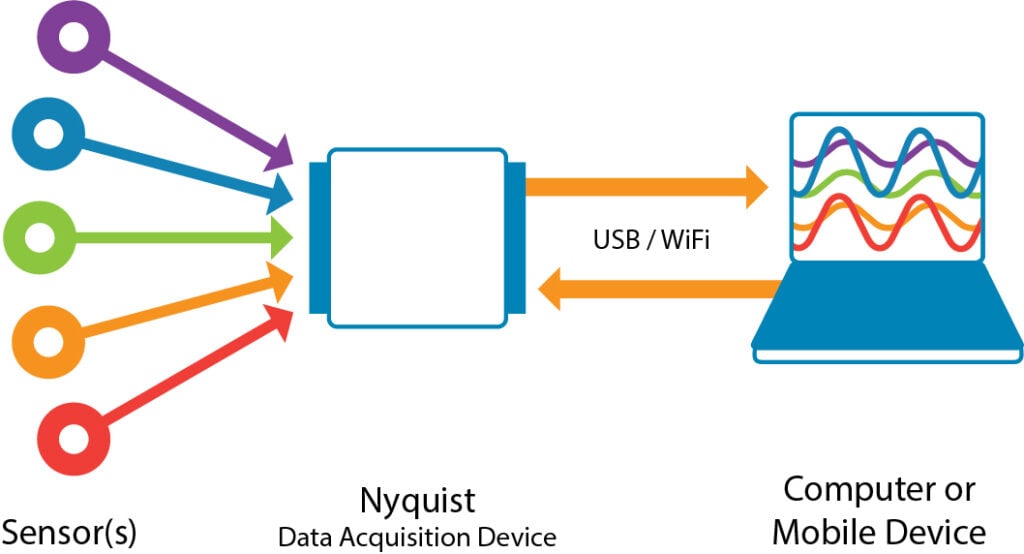
The DAQ device is the main piece of hardware that interfaces between the sensors transducing data and the computer saving the data. They typically interface to the computer using USB or other wired connection. Certain models, like the DAQiFi Nyquist also offer fully wireless communication over WiFi which enable convenient, wireless data acquisition. The DAQ device’s function is to sample the incoming sensor data and transfer the data to a traditional PC or other “smart” device. This data can be both digital or analog. Analog data must go through the additional step of analog to digital conversion in order to be processed and saved on a computer. DAQ devices can each offer different resolutions for converting analog signal to digital representations in order to help preserve the original signal.
What that looks like in code. Here’s the equivalent of “open a DAQiFi device, enable analog input 0, and stream samples at 1 kHz” in Python:
from daqifi import DAQiFiDevice

with DAQiFiDevice.discover_first() as dev:
    dev.channels.ai0.enable()
    for sample in dev.stream(rate_hz=1000):
        print(sample)
Same pattern works in C#, Java, LabVIEW, and Node.js. See the open-source stack page for examples in every supported language.
User Interface
The user interface is the final piece that ties everything together and provides the tools for the end user to work with the sampled data. User interfaces can vary greatly across DAQ systems, but should provide some method for the users to visualize the data being sampled and save it for later work. Larger scale systems may be able to incorporate multiple DAQ devices as well as user defined functions for combining multiple signals.
Picking a DAQ? Compare the Nyquist 1, 2, and 3 side-by-side — sample rate, resolution, channel count, and connectivity all in one table.
Applications
There are countless applications for data acquisition. Any physical phenomenon or physical property as a function of time is a candidate for data acquisition. Data acquisition is beneficial in both laboratory and industrial settings. However, with the advent of Internet of Things, data acquisition is now commonplace in the home, small business, or hobbyist garage. Educational applications range from middle school, afterschool programs, science camps, to high schools and universities. Engineering students, professors, and graduate researchers alike use DAQ systems everyday.
Below are some real-world examples of data acquisition applications.
Ready to get hands-on? The DAQiFi Nyquist line ships with open-source firmware, desktop software, and SDKs in five languages — see the open-source stack for what’s under the hood.
